Official project page and code release

Energy-Guided Flow Matching

Haoyang Tong*1,2, Yu He*2, Fang Li2, Lichen Ma2,3, Jingling Fu2, Dong Chen2, Zhen Chen2, Junshi Huang2, Jie Caoβœ‰1

1 MAIS & NLPR, CASIA 2 JD.com 3 Xi’an Jiaotong University

tonghaoyang22@mails.ucas.ac.cn, heyu2579@gmail.com, jie.cao@cripac.ia.ac.cn

*Equal contribution Corresponding author

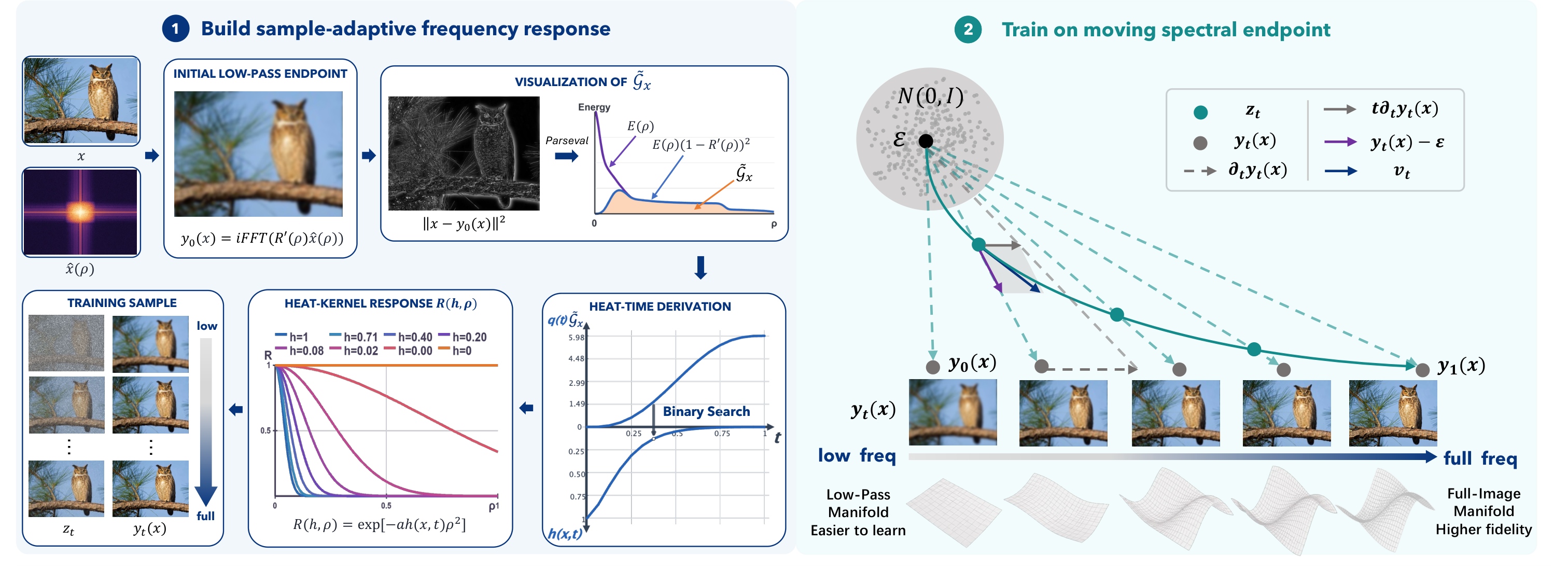
EG-FM explicitly models a coarse-to-fine generative trajectory by progressively releasing image frequency information through a sample-adaptive moving endpoint.

Paper Code ImageNet Checkpoint T2I Checkpoint Coming Soon Results

Interactive line chart comparing FID across training epochs for PixelDiT and DeCo, with and without Energy-Guided Flow Matching.

EG-FM reaches 1.55 FID at 200 epochsβ€”approximately 4Γ— faster than PixelDiT-XL.

ImageNet-256 Β· FID vs. training epochs

Faster convergence with EG-FM

Hover or focus a point for its value. Select a legend item to compare individual series.

Abstract

Pixel-space generative models bypass lossy latent compression, yet necessitate joint learning of global structure and fine-grained details in a high-dimensional space. Standard flow matching interpolates noise toward a fixed clean-image endpoint, leaving the spectral evolution to be learned implicitly. In this paper, we introduce Energy-Guided Flow Matching(EG-FM) that explicitly models a coarse-to-fine generative trajectory by moving endpoint. Specifically, EG-FM replaces the fixed endpoint with a heat-kernel-filtered endpoint that evolves smoothly from low-frequency image to clean image. The fraction of high-frequency signal in moving endpoint is released by an image-specific energy-guided scheduling, leading to the re-targeting of velocity in flow matching. Our framework requires no adaptation of the backbone and training data, bringing negligible cost on the training and inference stages. In our experiment, EG-FM consistently achieves lower FID on the ImageNet class-conditional image generation task at 256 Γ— 256 with fewer epochs, reaching an FID of 1.55 at 200 epochs and 1.45 at 600 epochs. We continue training the generation task on the setting of 512Γ—512 resolution, yielding a FID of 1.58 after only 40 high-resolution adaptation epochs. Furthermore, we transfer EG-FM on text-to-image generation and achieve 0.85 on GenEval score and 83.9 on DPG-Bench.
Method

Energy-Guided Flow Matching constructs an image-adaptive coarse-to-fine trajectory by replacing the fixed clean-image endpoint with a moving, heat-kernel-filtered endpoint. Each image follows its own spectral energy schedule, progressively revealing structure and detail while retaining an exact analytical velocity target for standard flow-matching training.

Overview of Energy-Guided Flow Matching from Figure 2 of the paper

Experiments

Quantitative results

Controlled comparisons across class-conditional and text-to-image generation.

ImageNet metrics use 50K generated samples and the ADM evaluation suite. Best EG-FM results are highlighted.

ImageNet 256 Γ— 256

Class-conditional generation

Table 1
MethodEpochsParamsNFEFID ↓sFID ↓IS ↑Prec. ↑Recall ↑
REPA800675M250Γ—21.424.70305.70.800.65
DDT-XL400675Mβ€”1.26β€”310.60.790.65
RAE-XL800839Mβ€”1.13β€”262.60.780.67
PixelFlow-XL320677M120Γ—21.985.83282.10.810.60
PixNerd-XL320700M100Γ—21.93β€”298.00.800.60
JiT-G6002.0B100Γ—21.82β€”292.60.790.62
PixelU-H/166001.17B100Γ—21.635.04305.90.790.64
DiP-XL/16600631M100Γ—21.794.59281.90.800.63
FREPix-XL320674M100Γ—21.914.59295.60.790.62
DeCo-XL/16600682M100Γ—21.694.59304.00.790.63
+ EG-FM440682M100Γ—21.634.78300.10.790.62
HyperDiT-H600952M100Γ—21.564.73306.50.800.64
+ EG-FM220952M100Γ—21.514.31293.40.780.64
PixelDiT-XL80797M100Γ—22.365.11282.30.800.57
PixelDiT-XL320797M100Γ—21.614.68292.70.780.64
PixelDiT-XL800797M100Γ—21.544.49297.00.780.65
+ EG-FM80797M100Γ—21.995.09280.80.810.61
+ EG-FM200797M100Γ—21.554.60296.20.790.65
+ EG-FM600797M100Γ—21.454.41299.60.780.65

ImageNet 512 Γ— 512

High-resolution class-conditional generation

Table 7
MethodEpochsParamsNFEFID ↓sFID ↓IS ↑Prec. ↑Recall ↑
DiT-XL/2600675M250Γ—23.045.02240.80.840.54
SiT-XL/2600675M250Γ—22.624.18252.20.840.57
REPA200675M250Γ—22.084.19274.60.830.58
PixNerd-XL†320700M100Γ—22.845.95245.60.800.59
JiT-H600956M100Γ—21.94β€”309.1β€”β€”
PixelU-H/326001.2B100Γ—21.925.98322.10.800.58
DiP-XL/32β€”631M100Γ—22.314.48291.70.840.58
DeCo-XL/16†340682M100Γ—22.224.67290.00.800.60
PixelDiT-XL†850797M100Γ—21.815.61278.60.780.67
+ EG-FM†240797M100Γ—21.684.77295.50.790.63
HyperDiT-H + EG-FM†260952M100Γ—21.584.90285.00.790.64

† Continued training from a 256 Γ— 256 checkpoint. NFE includes conditional and unconditional classifier-free-guidance evaluations.

Qualitative results

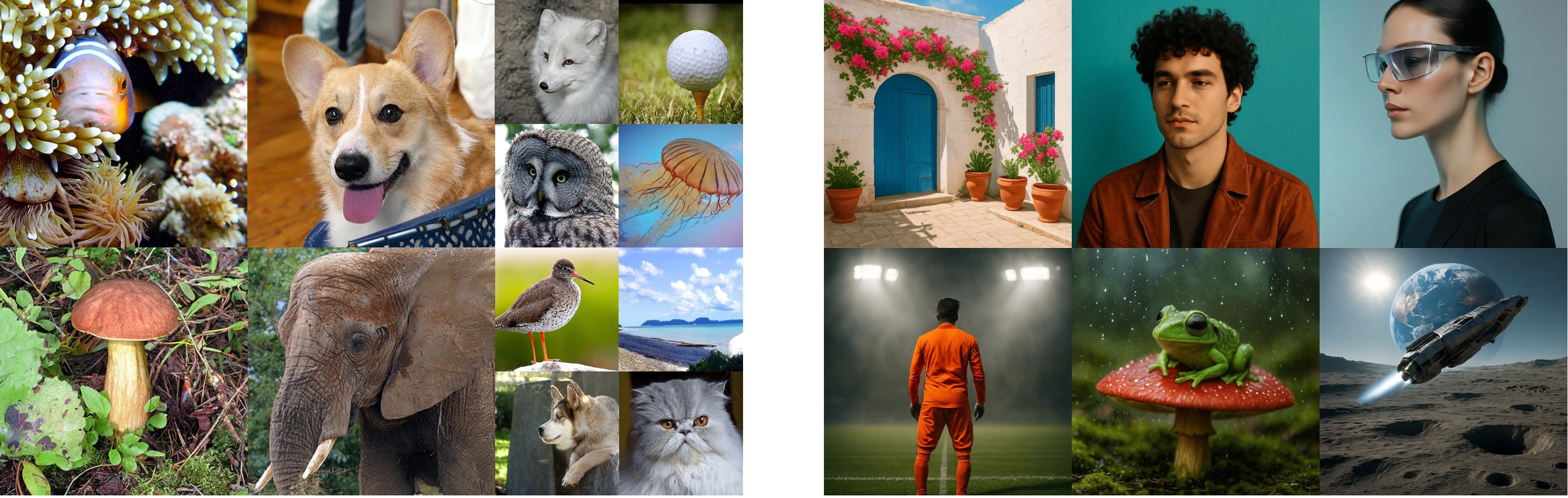
Qualitative class-conditional and text-to-image samples generated with EG-FM
Text-to-image samples generated with EG-FM
Text-to-image samples generated with EG-FM.

Citation

If you find this work useful, please cite:

@article{tong2026energy,
  title   = {Energy-Guided Flow Matching},
  author  = {Tong, Haoyang and He, Yu and Li, Fang and Ma, Lichen and Fu, Jingling and Chen, Dong and Chen, Zhen and Huang, Junshi and Cao, Jie},
  journal = {arXiv preprint arXiv:2608.05811},
  year    = {2026}
}